
Diamond Biofund has established the “Investment Operations Procedure” and “Investment Risk Control Procedure” to regulate the matters that must be followed in the investment process, from development, evaluation, decision-making, to post-investment management. The “Responsible Investment Policy” specifies that ESG and other sustainability factors should be considered in both investment evaluation and post-investment management, to manage ESG risks and enhance investment value. As of December 31, 2024, Diamond Biofund’s assets under management (AUM) were calculated using the amounts from the balance sheet under “Financial assets measured at fair value through profit or loss – current” and “Financial assets measured at fair value through profit or loss – non-current,” totaling NT$7,294,561 thousand.
| Investment Process | ESG Management in Investment Operations | |
|---|---|---|
| New project development and screening |
|
100% coverage of investment positions |
| Evaluation and due diligence |
|
100% coverage of investment positions |
| Investment decision-making |
|
100% coverage of investment positions |
| Post-investment management |
|
100% coverage of investment positions |
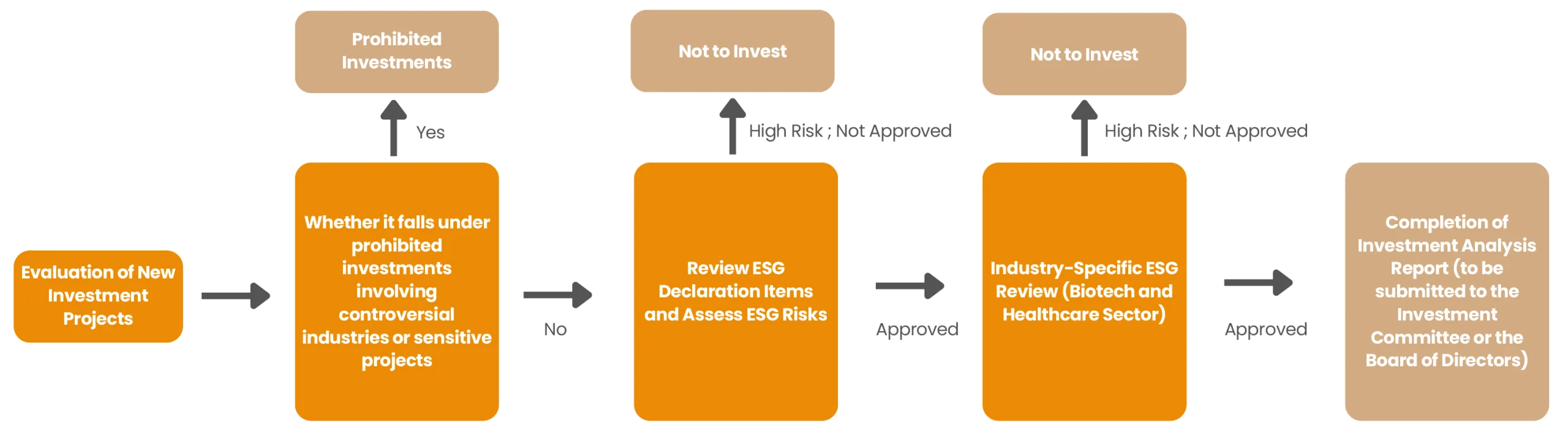
ESG Management Process Flowchart for “New Project Development and Screening” and “Evaluation and Due Diligence”:
In addition to incorporating ESG considerations at all stages before investment, Diamond Biofund believes that implementing “Active Ownership” after investment is also crucial. The company positively influences the ESG promotion and development of its portfolio companies through regular communication and dialogue with the management teams, proposing resolutions at board or shareholder meetings, expressing opinions, or participating in voting. Diamond Biofund’s “Investment Risk Control Procedure” requires the investment department to conduct at least quarterly interviews with portfolio companies and compile a “Quarterly Investment Management Report.” Through on-site visits, conference calls, and participation in board or shareholder meetings, the company maintains close interaction with its portfolio companies, focusing on industry development, business strategies, financial information, corporate governance, environmental protection, and corporate social responsibility issues. In 2024, Diamond Biofund achieved 100% attendance at shareholder meetings and 100% attendance at board meetings of its portfolio companies.
2024 Status of ESG-Related Proposal Support at Portfolio companies Companies’ Shareholders’ Meetings
| Type | Number of Proposals | Support Ratio |
|---|---|---|
| E Environmental Proposals | 0 | NA |
| S Social Proposals (e.g., Employee Compensation Related) | 1 | 100% |
| G Governance Proposals (e.g., Board of Directors and Supervisors, Regulatory and Governance Related) | 48 | 100% |