
It is generally believed that by incorporating ESG factors into investment decisions and management processes, asset management companies can reduce financial losses or reputational impacts when facing environmental and social risks, thereby enhancing operational resilience. In recent years, as global governments and regulatory agencies have actively guided capital towards ESG-related projects, more institutional investors are demanding that their funds be invested in projects that align with sustainable development goals, pursuing long-term value and stable returns. Therefore, ESG is no longer merely a representation of philanthropy and social responsibility but has become a crucial component of corporate operations and investment decision-making.
Diamond Biofund focuses on the biotechnology and healthcare investment sector, targeting competitive biotech startups involved in new drug development, advanced medical devices, innovative medical services, medical distribution, and agricultural biotechnology. This year, in addition to disclosing our company’s environmental information, we also included important environmental-related information for seven of our portfolio companies: Cho Pharma, Inc., Sinew Pharma Inc., StemCyte International Ltd.(StemCyte-KY), Tetanti AgriBiotech Inc., Syncell Inc., Diamond Biofund I Inc., and Diamond Biofund II Inc. As of December 31, 2024, the total book value (i.e., fair value) of these seven portfolio companies accounted for 97.21% of Diamond Biofund’s total book value of “financial assets measured at fair value through profit or loss—current and non-current.”
The Board of Directors of Diamond Biofund serves as the highest governance body for climate-related matters. The board members possess relevant expertise and are responsible for overseeing and managing climate-related risks and opportunities, as well as driving the company’s overall climate strategy and policies. The Board incorporates climate issues as a key consideration in corporate governance and business strategy, sets climate-related action targets, and integrates climate risk management into the company’s overall risk management and control framework. The Board also evaluates and continuously optimizes the implementation of various risk management mechanisms to ensure sound operations. Under the Board, the Sustainable Development and Nominating Committee has been established, chaired by an independent director.
Diamond Biofund has established a Sustainability and Risk Management Task Force, which is led by the President’s Office under the supervision of the President. The task force is responsible for coordinating climate governance policies and related initiatives, as well as conducting climate risk assessments and developing response actions. Under the Sustainability and Risk Management Task Force, there are three functional sub-group/teams: Corporate Governance, Social Engagement, and Sustainable Finance. Departments participate in each sub-group/teams based on their business functions and responsibilities. The Sustainability and Risk Management Task Force reports at least once a year to the Sustainable Development and Nominating Committee and the Board of Directors on the status of risk management operations. It also requires each unit to develop corresponding control measures, thereby enhancing risk management mechanisms and ensuring the achievement of long-term sustainability goals.
To effectively implement climate governance strategies and policies, Diamond Biofund, with the approval of the Remuneration Committee and the Board of Directors, has incorporated ESG-related key performance indicators (KPIs) into the performance bonus evaluation of senior management (including the President and Vice Presidents), with a minimum weighting of 5%. These KPIs are directly linked to the achievement of ESG goals.
In addition, department heads responsible for relevant ESG initiatives are also evaluated based on ESG-related performance metrics. This top-down performance evaluation mechanism is intended to strengthen the implementation of sustainability practices and reinforce the core principles of climate governance throughout the organization.
Board of Directors
■ Acts as the highest decision-making and supervisory body for sustainable development and sustainability information management.
Sustainable Development and Nominating Committee
Sustainable Development and Risk Management Task Force
(President’s Office)
Corporate Governance Team
Corporate Governance
Risk Management
Ethical Management
Information Transparency
Legal Compliance
Social Engagement Team
Talent Development
Diversity and Equality
Occupational Health and Safety
Participation in Public Welfare Activities
Industry–Academia Collaboration
Sustainable Finance Team
Responsible Investment
Climate Resilience
Diamond Biofund organized a climate risk workshop, bringing together dedicated personnel from various departments and senior management for joint discussions. A climate risk questionnaire was also distributed to portfolio companies to analyze the potential short-, medium-, and long-term physical and transitional risks faced by Diamond Biofund, as well as related business opportunities. The insights gathered will be used to develop mitigation and adaptation strategies, thereby strengthening the company’s climate resilience.
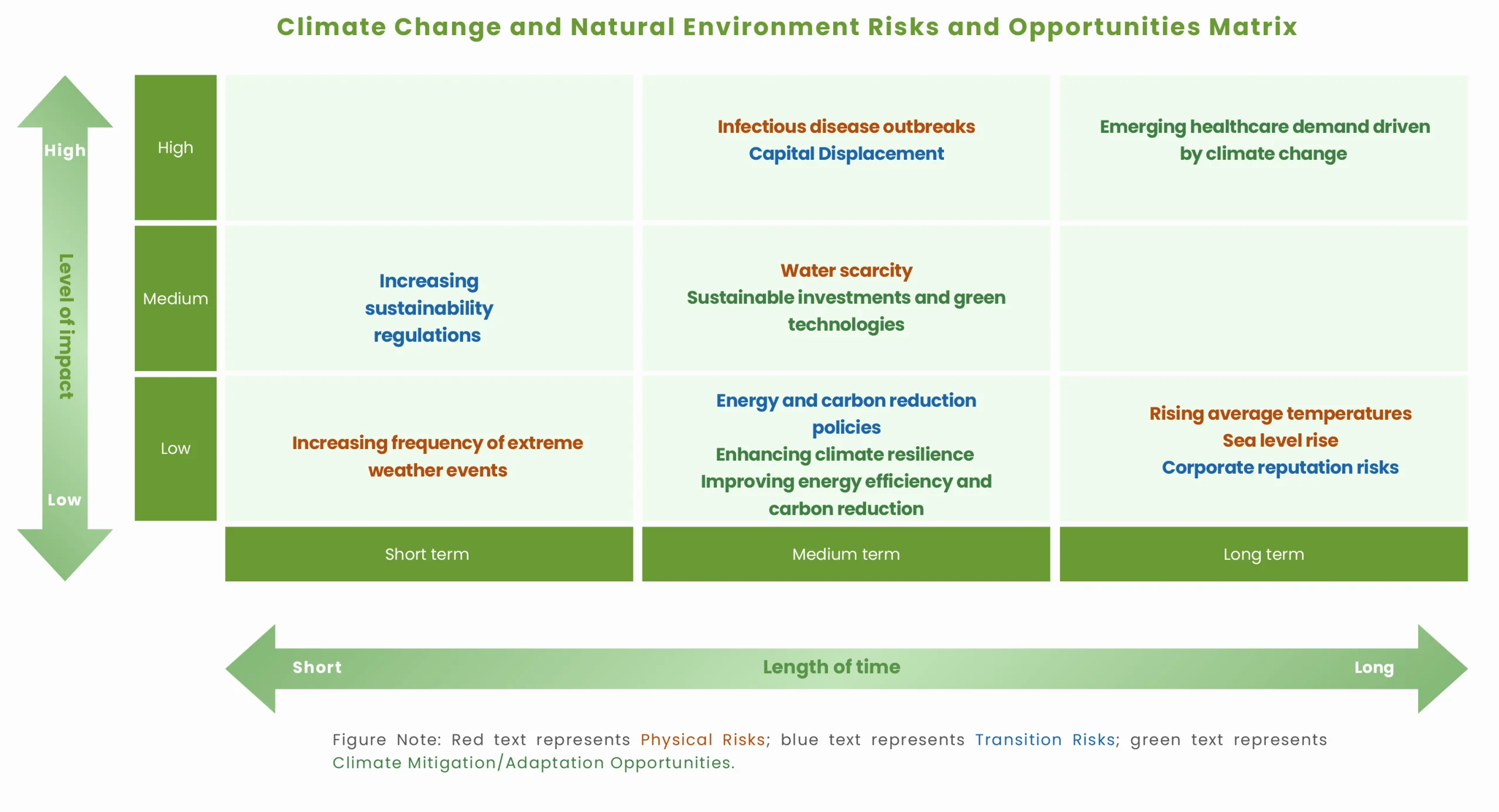
| Risk Category | Climate Risk Factor | Timing of impact | Scope of impact | Disclosure of Financial Impacts from Climate Risks | Response Strategy | |
| Portfolio Companies |
Own operations |
|||||
| Physical Risks | Increasing frequency of extreme climate events | Short term | ✅ | ✅ | Increasing frequency of extreme climate events—such as typhoons and torrential rains—may lead to disasters including strong winds, flooding, and landslides, potentially causing casualties or damage to equipment. These events may impact the company’s operational performance or result in increased capital expenditures for disaster prevention. Furthermore, if such events affect the R&D, production, or operational stability of portfolio companies, the company’s investment performance may also deteriorate as a result. | The company’s leased office premises are equipped with disaster prevention facilities, which are regularly inspected and maintained. Annual emergency drills are conducted to ensure timely and effective response to disaster events, thereby minimizing potential losses. In addition, the company has established sustainability goals aimed at mitigating the pace of climate change and actively encourages its portfolio companies to follow suit. |
| Infectious disease outbreaks | Medium term | ✅ | ✅ | A warming climate may facilitate the proliferation of pathogens, potentially leading to outbreaks and epidemics of infectious diseases. Such events may cause temporary suspension or disruption of the company’s operations. If portfolio companies are also affected—for example, through delays in clinical trials or the recruitment of healthy volunteers—this may lead to setbacks in their R&D progress, which in turn could negatively impact the company’s overall investment performance. | By formulating emergency response plans, the company aims to ensure business continuity and minimize potential losses. Annual initiatives are conducted to promote employee health protection and hygiene awareness, while resources are also planned to support remote work when necessary. In addition, the company encourages portfolio companies to enhance R&D flexibility, diversify clinical trial deployment, and establish their own emergency response mechanisms, in order to mitigate the impact of operational disruptions and delays in R&D progress. | |
| Water scarcity | Medium term | ✅ | ✅ | Drought-induced water scarcity may result in water supply interruptions, shortages, or increased water costs, thereby affecting the company’s operational performance or leading to additional capital expenditures (e.g., for water storage systems). If such conditions extend to biopharmaceutical production processes—including fermentation, cell culture, and drug manufacturing—they may hinder the R&D or production efficiency of portfolio companies, which could in turn negatively impact the company’s investment performance. | The company has established a supplier management procedure and adopted water storage systems and water-saving devices to promote water conservation and ensure uninterrupted operations despite potential water scarcity. In addition, portfolio companies are encouraged to strengthen water management in critical processes such as biological fermentation, cell culture, and drug manufacturing, in order to mitigate the impact of water shortages on R&D and production efficiency and to maintain stable investment performance. | |
| Rising average temperatures | Long term | ✅ | ✅ | Rising average temperatures may lead to heat-related injuries or wildfires, potentially resulting in casualties or damage to equipment. These incidents may affect the company’s operational performance or require increased capital expenditures for disaster prevention. If such conditions also disrupt the R&D, production, or operational stability of portfolio companies, the company’s investment performance may further decline as a result. | The company’s leased office premises are equipped with air conditioning and ventilation systems, and fire extinguishers have been procured and are regularly inspected and maintained. Annual emergency drills are conducted to ensure timely disaster response and minimize potential losses. Portfolio companies are encouraged to implement high-temperature and fire risk management measures, along with regular drills, to reduce the impact of extreme heat on R&D, production, and operational stability, thereby helping to ensure stable investment performance. | |
| Sea level rise | Long term | ✅ | ✅ | Rising sea levels may lead to permanent inundation of coastal areas, as well as more severe storm surges associated with heavy rainfall or typhoons. These events may affect the company’s operational performance or result in increased capital expenditures for disaster prevention. If the locations of portfolio companies are also impacted—such as being submerged—this may disrupt their R&D or production efficiency, thereby further diminishing the company’s investment performance. | When relocating offices or constructing new facilities, the company avoids selecting sites in low-lying areas. In the event of natural disasters, operations follow official work suspension announcements issued by competent authorities to ensure employee safety. Portfolio companies are also encouraged to assess flood risks at their plant locations and evaluate the resilience of their facilities, while proactively planning adaptation measures to reduce the impact of sea level rise on operations and investment performance. | |
| Transition Risks | Increasing sustainability regulations | Short term | ✅ | ✅ | The increasing requirements of sustainability regulations—such as sustainability disclosures, the adoption of IFRS standards, and climate risk assessments—are expected to raise operating costs for both the company and its portfolio companies, potentially affecting the company’s investment performance. | The company continuously monitors trends in sustainability regulations, carefully assesses related risks, and develops appropriate response strategies. In addition to strengthening engagement with portfolio companies—encouraging or requiring them to set sustainability goals and promote ESG initiatives—the company also provides operational guidance as needed. This includes urging portfolio companies to comply with relevant regulations and periodically sharing the latest international standards, regulatory requirements, and legal knowledge. |
| Capital displacement | Medium term | ✅ | ✅ | Regulatory authorities are formulating sustainable investment regulations—such as sustainable taxonomy frameworks—to steer capital toward low-carbon industries. This may result in capital crowding-out effects, making fundraising more difficult for other sectors. | To ensure that the investment process complies with sustainability-related regulations, the company has established a Responsible Investment Policy, integrating net-zero carbon strategies into the development, evaluation, and post-investment management of potential portfolio companies. The company proactively supports portfolio companies in developing low-carbon transition strategies and enhancing their sustainability disclosure capabilities to strengthen their fundraising potential and market competitiveness. | |
| Energy and carbon reduction policies | Medium term | ✅ | ✅ | Stricter government regulations on energy conservation and carbon reduction—such as mandatory use of a certain percentage of renewable energy, more stringent environmental impact assessment requirements, and expanded carbon fee schemes—along with rising electricity prices, may increase operating costs for both the company and its portfolio companies, thereby negatively impacting the company’s investment performance. | The company promotes energy-saving management and the use of renewable energy, and encourages portfolio companies to implement carbon inventory and energy conservation and carbon reduction initiatives. These efforts aim to enhance regulatory compliance capabilities and energy efficiency, thereby reducing the impact of carbon fees and rising electricity costs on operating expenses and investment performance. | |
| Corporate reputation risk | Long term | ✅ | ✅ | Failure to actively pursue low-carbon transition and relatively lagging sustainability performance may damage the reputation of both the company and its portfolio companies. This could lead to increased negative feedback from stakeholders, reduced access to capital, and ultimately, higher operating costs. |
|
|
Transition Risk – Financial Impact Analysis of Energy and Carbon Reduction Policies on Portfolios
To strengthen climate resilience, the workshop not only focused on risk reduction but also identified potential development opportunities arising from climate change adaptation.
| Opportunity Factor | Opportunity Description | Response Strategy | |
| Climate Mitigation Opportunities | Sustainable investment and green technology | In response to the global trend toward net-zero carbon emissions, the company actively monitors and strategically positions itself in low-carbon operations, green energy development, and circular economy industries, aiming to generate sustainable investment returns. | One of the company’s current portfolio companies, Tetanti AgriBiotech Inc., focuses on the reutilization of organic waste and has developed “targeted enzyme” technology with carbon reduction potential. Looking ahead, the company will continue to seek out potential biotech investments with promising sustainability applications. |
| Climate Adaptation Opportunities | Strengthen climate resilience | The company is committed to building climate resilience for both itself and its portfolio companies to maintain stable operations and reduce the risk of disruptions and associated losses caused by climate change. | The company has implemented a climate risk assessment mechanism and established emergency response plans and annual drills to enhance its ability to respond to climate-related risks, thereby reducing the risk of operational disruptions and associated losses. In addition, the company supports portfolio companies in developing adaptation strategies and business continuity measures to improve overall resilience to climate impacts and to effectively capture transition opportunities and long-term investment value. |
| Enhance energy efficiency and carbon reduction | Participating in renewable energy projects and implementing energy-saving measures to reduce operating costs. | The company and its portfolio companies continue to promote the replacement of energy-saving equipment and the implementation of renewable energy projects. Through internal training and awareness campaigns, overall energy efficiency awareness is being strengthened. Energy conservation and carbon reduction are increasingly emphasized as key operational priorities, aiming to reduce operating costs and create sustainable value. | |
| Emerging Healthcare Demand Driven by Climate Change | Climate change is altering disease patterns, increasing demand for innovative healthcare, epidemic prevention, and preventive medicine. This trend is driving growth in the biotech and pharmaceutical industries, thereby creating investment opportunities and potential returns. | The company closely monitors emerging technologies related to climate-induced diseases and invests in high-potential sectors such as biotechnology, healthcare, and preventive medicine to capture growth opportunities in innovative medical solutions. Portfolio companies are also encouraged to expand R&D and applications in these areas to address unmet medical needs, balancing social value with investment returns. |
To strengthen corporate governance and establish effective risk management mechanisms, the company assesses and monitors risk tolerance and management. In 2022, the Board of Directors approved the “Risk Management Policies and Procedures” as the company’s highest guiding principles for risk management. The company integrates and manages various potential risks that could affect operations and profitability, implementing early warning measures and appropriate preventive actions to maintain operational activities in case of incidents.
The Sustainable Development and Risk Management Task Force is the designated unit responsible for implementing and assessing climate risk management. It operates independently from business units and daily operations. The task force is organizationally positioned under the President’s Office and regularly reports to the Sustainable Development and Nominating Committee as well as the Board of Directors.
The company’s climate risk and opportunity management process is mainly divided into the following steps: identification, assessment, monitoring and reporting, and response.

Each department is responsible for identifying relevant risks and opportunities, as well as assessing and analyzing their potential impact on operations. The Sustainable Development and Risk Management Task Force consolidates these assessments to form an integrated view of overall risks and opportunities. The Task Force regularly reports to the Sustainable Development and Nominating Committee and the Board of Directors, which oversee the implementation of risk management. Climate-related risks are managed as part of the company’s overall risk management framework and are integrated with other risk factors for unified control and monitoring.
Risk Control Indicators
Based on the major climate risk matrix identified in 2024, the company has set control indicators for high-impact risks to ensure the risks remain within acceptable levels.
| Risk Factor | Indicator | Response actions |
| Infectious disease outbreaks | Investment management | Conduct quarterly interviews with portfolio companies and compile the “Quarterly Investment Management Report” to ensure that R&D progress remains on schedule without delay. |
| Increasing frequency of extreme climate events | Drills, training programs, and remote resource planning |
|
| Capital displacement | Information transparency |
|
| Energy and carbon reduction policies | Corporate greenhouse gas emission reduction |
|
In June 2024, Diamond Biofund conducted its first greenhouse gas inventory for FY2023, covering the parent company and its subsidiaries. To ensure the transparency and accuracy of carbon emission data, third-party verification is conducted annually. The 2024 greenhouse gas inventory was verified by AFNOR ASIA in accordance with the ISO 14064-3:2019 standard.
| Scope 1 Greenhouse Gas Emissions | 2023 | 2024 |
| Emissions (metric tons CO₂e) | 6.8150 | 11.5250 |
| 2024 | CO₂ | CH₄ | N₂O | NF₃ | SF₆ | PFCs | HFCs | 合計 |
|---|---|---|---|---|---|---|---|---|
| Scope1 | 11.3454 | 0.0167 | 0.1630 | 0.0000 | 0.0000 | 0.0000 | 0.0000 | 11.5250 |
| Scope 2 Greenhouse Gas Emissions | 2023 | 2024 |
| Emissions (metric tons CO₂e) | 60.8820 | 82.1897 |
| Scope 3 Greenhouse Gas Emissions | 2023 | 2024 |
| Emissions from shared electricity usage (metric tons CO₂e) |
61.1260 | 123.0591 |
| Emissions from business travel (metric tons CO₂e) |
33.8610 | 33.7742 |
| 2023 | 2024 | |
|---|---|---|
| Scope 3 – Investment Emissions (metric tons CO₂e) |
269.7050 | 121.4695 |
| Data Coverage (Note 1) |
77.02% | 97.21% |
| Carbon Footprint Intensity (Scope 3 – Investments) (metric tons CO₂e per million AUM) (Note 2) |
0.0825 | 0.0171 |
| Names of Portfolio Companies Included in the Calculation (Note 3) |
Oneness Biotech Co., Ltd., CHO Pharma Inc., StemCyte International Inc.(StemCyte-KY), Sinew Pharma Inc., and Tetanti AgriBiotech Inc. |
CHO Pharma Inc., StemCyte International Inc.(StemCyte-KY), Sinew PharmaInc., Syncell Inc., Tetanti AgriBiotech Inc., Diamond Biofund I Inc., and Diamond Biofund II Inc. |
Note 1:The total data coverage is calculated based on the total book value of “financial assets at fair value through profit or loss – current and non-current” held by Diamond Biofund.
Note 2:The Company’s operating income for 2023 and 2024 was negative; therefore, intensity is calculated based on carbon emissions per million of Assets Under Management (unit: metric tons CO₂e per million AUM).
Note 3:The greenhouse gas emission data used were calculated based on raw data collected from the portfolio companies. The results for 2024 and 2023 were subject to limited assurance by AFNOR ASIA and DNV, respectively.
| Metric tons CO₂e | Metric tons CO₂e per million AUM | |
| New Drug R&D / Cell and Gene Therapy | 107.9551 | 0.0389 |
| Applied Biotechnology (including Agricultural Biotechnology and Laboratory Instruments) |
13.5143 | 0.0514 |
| Venture Capital Funds | 0.0000 | 0.0000 |
Diamond Biofund completed its first greenhouse gas inventory and verification for the year 2023 in June 2024. In accordance with SASB guidelines, emissions from portfolio companies were included in the Scope 3 disclosure.
Following the completion of the group’s greenhouse gas inventory in 2024, Diamond Biofund proactively adopted carbon reduction measures and established ambitious emission reduction targets. These targets were approved by the Board of Directors on December 23, 2024, with 2024 set as the base year, and are outlined as follows:
| 【Scope 1、2】Operation | Adopt an absolute reduction method using 2024 as the base year, aiming to reduce Scope 1 and Scope 2 greenhouse gas (GHG) absolute emissions by 25% by 2030. In the long term, the Company aims to align with the 2050 net-zero emissions target. |
| 【Scope 3】Investment | Using the engagement approach, by 2030, 33% of the book value of Diamond Biofund’s investment portfolio must either have committed to or established their own carbon reduction targets. |
Diamond Biofund will reduce carbon emissions by continuously promoting energy-efficient equipment upgrades, evaluating renewable energy projects, and implementing internal training programs and awareness campaigns on energy conservation and carbon reduction.
Moreover, recognizing that one of our primary emission sources stems from Scope 3—namely, our portfolio investments—we strive to extend our influence and work alongside investee companies to tackle climate change. Each year, we include emissions from investment assets representing at least 80 percent of our total portfolio by book value in our greenhouse gas inventory, support investees in conducting their own GHG inventories and incorporating those data, and, through targeted training, cultivate climate-focused mindsets within those companies. We further guide them in developing their emissions registers and assist in establishing their greenhouse gas reduction targets.
With Taiwan’s carbon fee regime taking effect in 2025 and the EU’s Carbon Border Adjustment Mechanism (CBAM) being implemented, companies are facing the challenges of a carbon-priced era. Starting in Sep. 2025, Diamond Biofund has adopted a Shadow Carbon Price as an internal carbon pricing tool. By setting a non-levied carbon cost, the Company progressively internalizes carbon price impacts into operating decision-making processes.
At the initial stage, the Company’s internal carbon pricing is based on Scope 1 (direct emissions) and Scope 2 (purchased electricity), and is embedded into evaluations related to achieving reduction targets, phasing out energy-intensive equipment, procuring energy-efficient solutions, or purchasing renewable electricity (green power). Going forward, subject to ongoing implementation reviews, the Company will expand application toward Scope 3 by incorporating ICP into assessments of investment targets.
Diamond Biofund references the long-term price corridor proposed by the Carbon Fee Review Committee of the Ministry of Environment and international carbon-price forecasts. Considering feasibility at the outset, the Company has provisionally set an internal carbon price of NT$1,500 per tCO₂e, which is incorporated into various decision evaluations. The internal carbon price level will be reviewed annually to reinforce the Company’s decarbonization commitment.
| Application | Intended Purpose |
|---|---|
|
1. Target-setting and emissions reduction — To implement the Company’s reduction targets and align with Taiwan’s Climate Change Response Act and the 2050 net-zero policy, the Company targets a 25% reduction in GHG emissions by 2030 relative to the 2024 baseline year. ICP is used as a reduction tool for Scope 1 and Scope 2 emissions to encourage employee actions; results are incorporated into managerial performance appraisals, meeting stakeholder expectations on decarbonization. |
|
|
2. Evaluation of retiring energy-intensive equipment, procuring energy-efficient solutions, or purchasing green power — ICP internalizes the external cost of carbon emissions and serves as a reference basis for future capex decisions such as equipment replacement, energy-efficiency upgrades, or renewable electricity procurement. |
|
|
3. Evaluation of new investment targets — At this stage, ICP is applied primarily to Scope 1 and Scope 2 emissions. Subject to implementation results, application will be expanded to Scope 3, including assessments of new investment targets. Example: incorporating ICP into cost of capital for investment decisions—i.e., factoring potential carbon costs into the calculation of risk-adjusted cost of capital. |
|
|
4. Assessing climate risks and opportunities — ICP is used to evaluate the financial materiality of different climate risks and potential opportunities. |
|