
Businesses should not only focus on creating value and generating returns for shareholders but also promote good corporate governance and contribute positively to the environment and society. To gain a more comprehensive understanding in the decision-making process, we view stakeholder engagement as a crucial aspect of sustainable operations. By understanding stakeholders’ expectations of the company, identifying and managing operational and sustainability risks, we can improve decision-making quality, enhance the company’s image, and promote success.
Diamond Biofund conducts a material topic identification process once a year. Diamond Biofund references the AA1000 Accountability Principles Standard, using the four principles of ‘Inclusivity, Materiality, Responsiveness, and Impact’ to identify material topics. Through diverse communication channels with stakeholders, we assess the actual and potential impacts of environmental, social, governance, and human rights issues, which serve as the basis for the annual sustainability report disclosures and provide a reference for planning sustainability strategies.
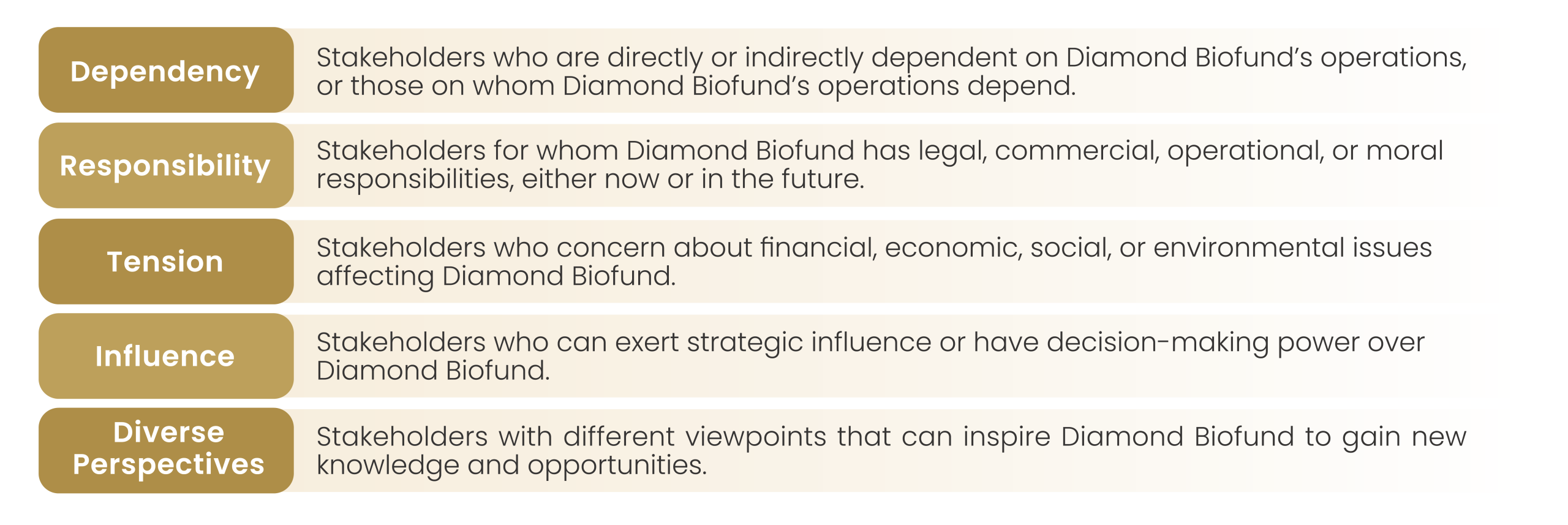
We refer to the AA1000 Stakeholder Engagement Standard (SES) and define six major stakeholder categories based on the five characteristics of “Dependency, Responsibility, Influence, Diverse Perspectives, and Tension.” These categories include regulatory authorities, shareholders/potential investors, portfolio companies, employees, suppliers, communities, and media. Through various channels and both regular and ad-hoc engagements, we understand stakeholders’ expectations of the company, assess the impact of each concern, and respond through this report and the company’s website.
To strengthen the company’s focus on stakeholders’ interests and understand their concerns, the company has established relevant communication channels and regularly reports the communication status with stakeholders to the Board of Directors. The stakeholder engagement in 2025, including key concerns, communication channels, frequency, and outcomes, will reported to the Board of Directors on the first quarter of 2026, as shown in the table below.
| Key Stakeholders | Importance to Diamond Biofund |
Issues of Concern |
Communication Channels/Frequency |
Communication Achievements |
| Competent Authorities | In compliance with government regulations, the Company ensures stable operations and regularly discloses information related to finance, business, corporate governance, and sustainability on public information platforms and the company website. |
|
|
|
| Shareholders/ Potential Investors | To protect shareholders’ rights and treat all shareholders fairly, the Company discloses all information in a timely, transparent manner and maintains good communication with shareholders and other stakeholders. |
|
|
|
| Portfolio Companies | Maintaining close communication with the management teams of portfolio companies, focusing on their R&D, operations, and sustainability issues helps implement post-investment management and responsible investment. |
|
|
|
| Employees | Talent is the company’s most important asset, crucial to its competitiveness and the foundation for sustainable development. The Company offers competitive salaries, year-end bonuses, and employee profit-sharing, along with comprehensive benefits, equal job opportunities, a friendly and safe work environment, and complete training to enhance employees’ professional skills and self-worth. |
|
|
|
| Community | Focusing on environmental protection, long-term involvement in social welfare, and industry-academia cooperation, the company leverages its influence to support social development and fulfill corporate social responsibility. |
|
|
|
| Media | Supporting company development by releasing news and engaging with the media on business performance and development trends. |
|
|
|
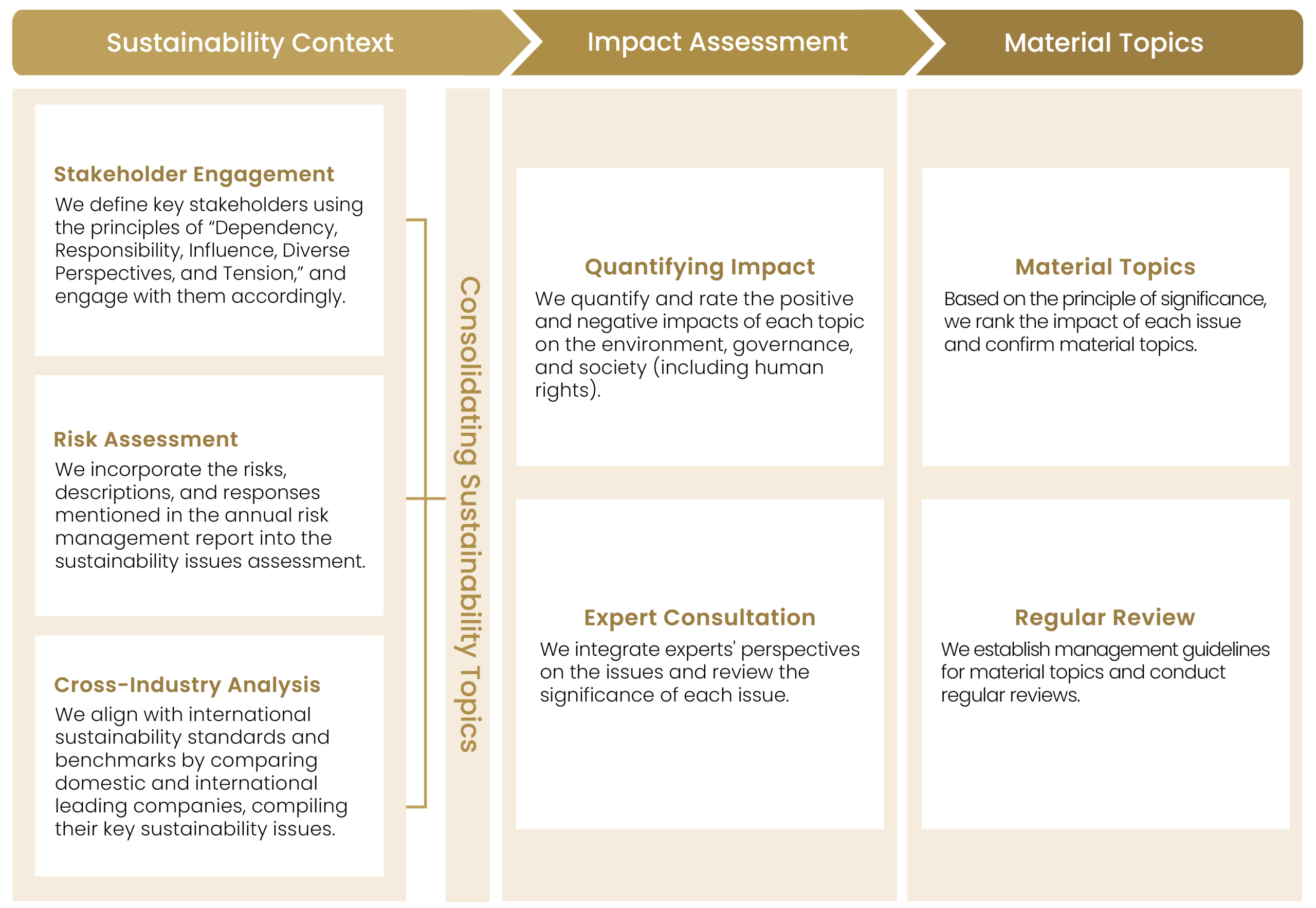
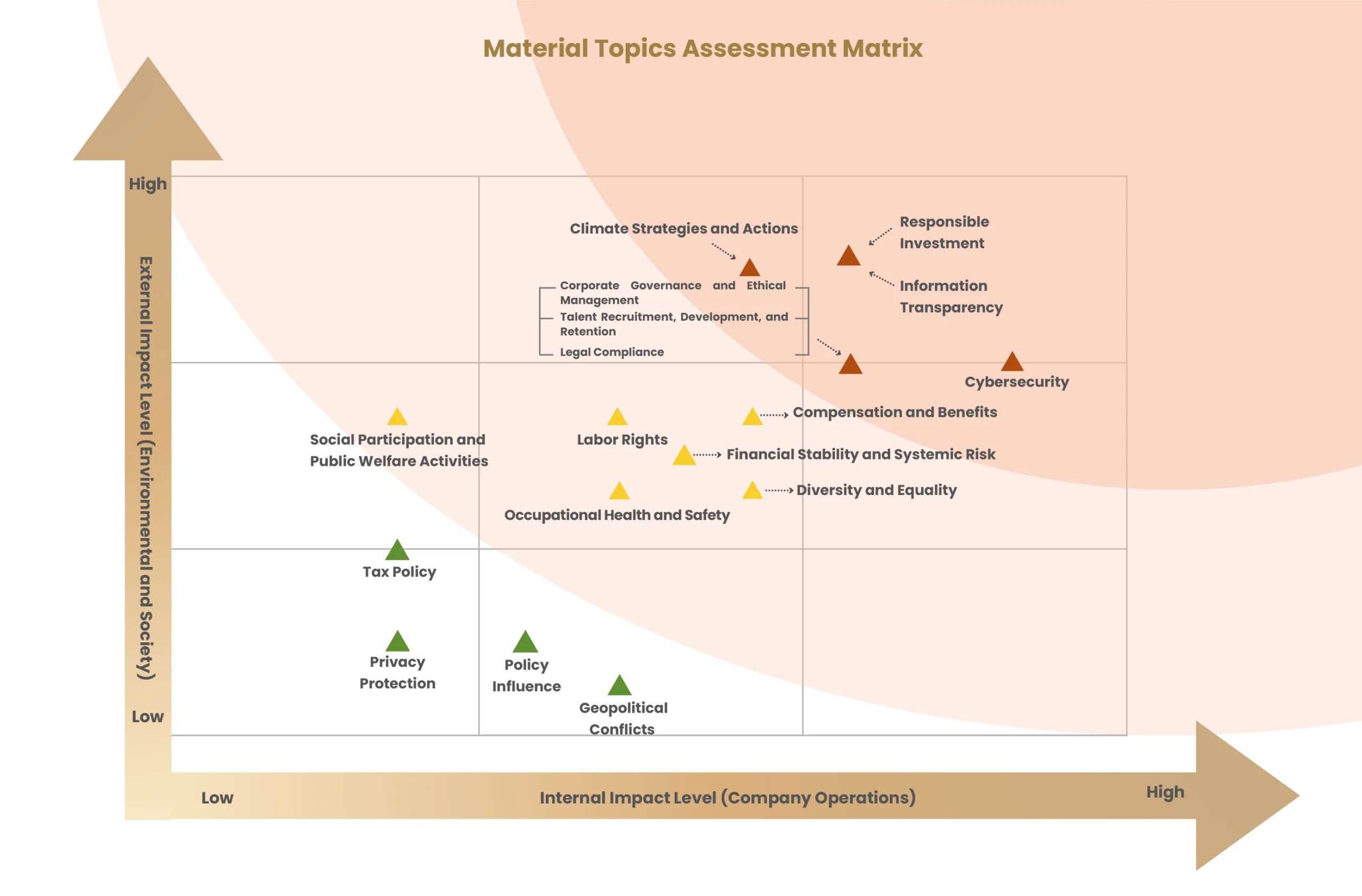
The Company consolidates the results of risk assessments, stakeholder communication issues, and cross-industry analyses (including the S&P Global Corporate Sustainability Assessment, the United Nations Sustainable Development Goals, etc) into a broad range of sustainability issues, identifying 17 topics as the basis for impact assessments.
Referencing the new GRI standards, quantitative indicators are used to evaluate the positive and negative impacts of each issue. The scoring principle involves analyzing the positive and negative impact levels and the probability of the topics occurring through due diligence on the impact pathways of the topics. This is based on the dual materiality principle of “inside-out,” meaning the company’s impact on the external environment and society, and “outside-in,” meaning the external impact on the company’s operations. The product of these two factors is used to determine the impact level.
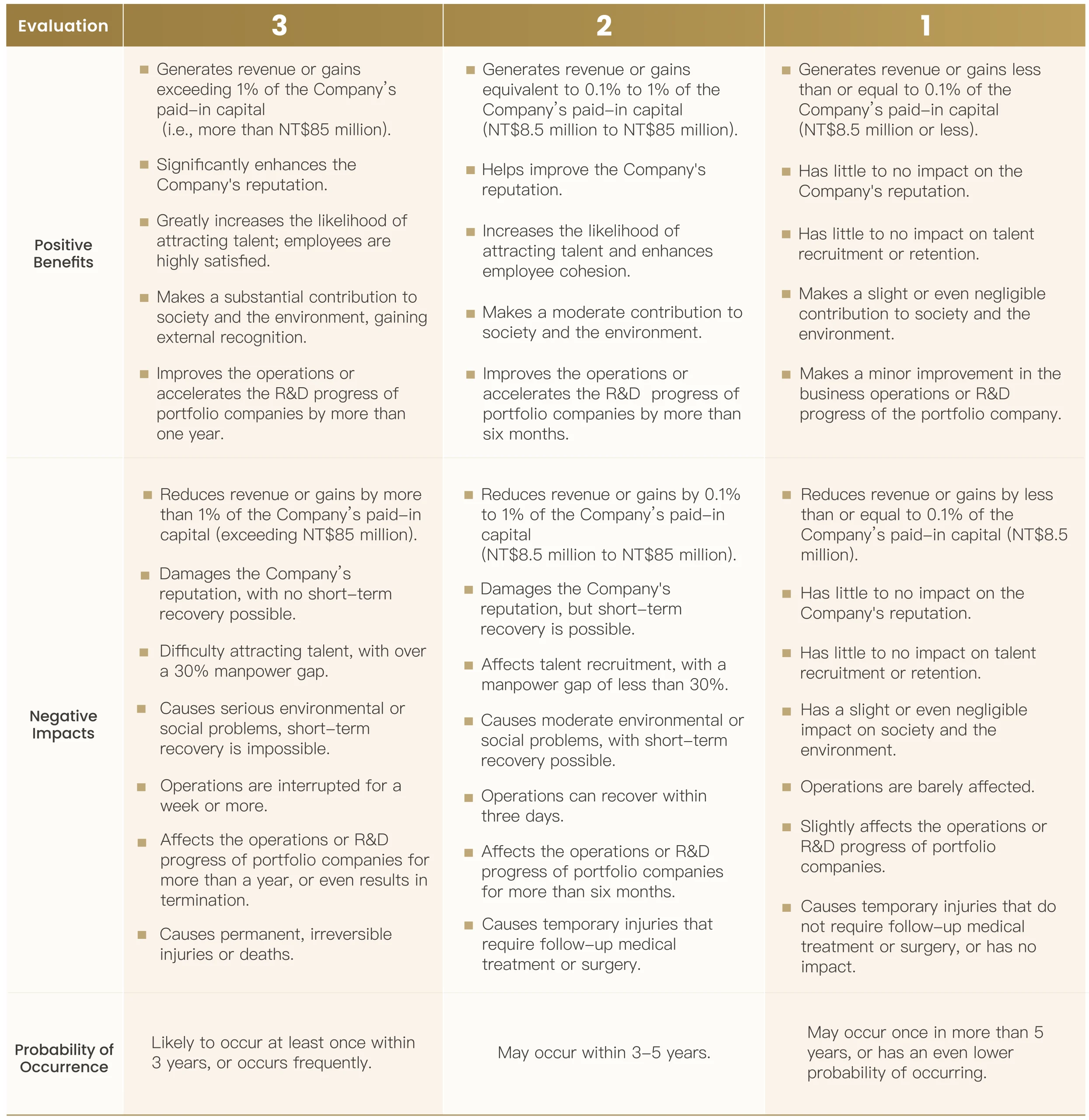
To ensure that the evaluation of each issue is appropriate and accurate, and that the information of concern to stakeholders is fully disclosed, the evaluation results are submitted to department heads for review. Department heads are on the front lines of dealing with external changes and are in direct contact with various stakeholders, making them familiar with the internal impacts of each issue on the company. They can be considered internal experts. Therefore, department heads review the impact pathways and accuracy of the evaluations based on their expertise in their respective fields.
After reviewing and adjusting the evaluation results of the topics, the positive benefits and negative impacts are combined to determine the impact level, and the top third of the impact levels are defined as the significance threshold. After ranking the topics by impact level, the company categorizes all topics into three types. In addition to disclosing material topics that cross the significance threshold as required by the GRI standards, the company also explains and discloses information related to disclosure topics in the report.
According to the above principles, there are seven material topics for this year, including “Responsible Investment,” “Information Transparency,” “Cybersecurity,” “Corporate Governance and Ethical Management,” “Talent Recruitment, Development, and Retention,” ” Climate Strategies and Actions,” and “Legal Compliance.”
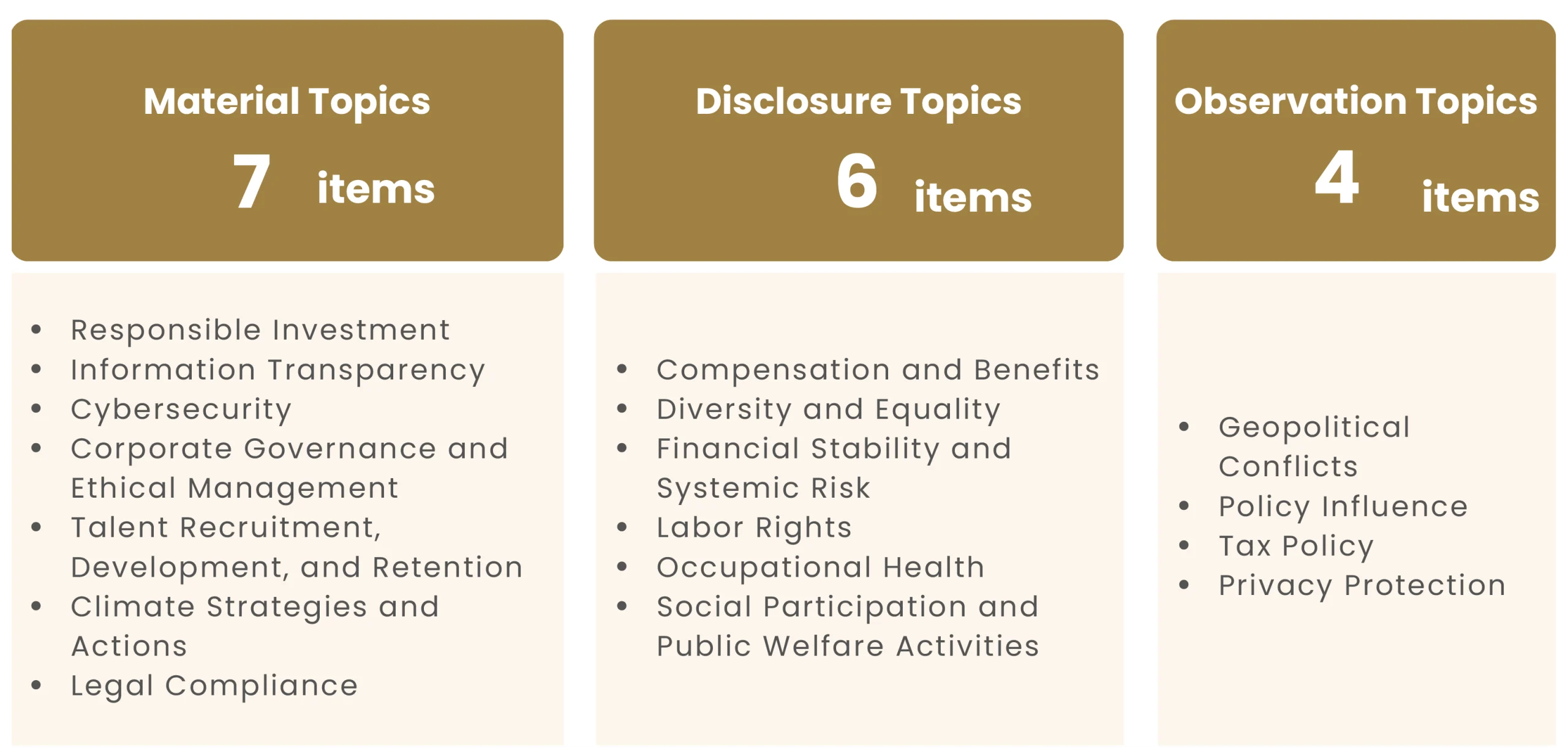
Note 1: Business performance (including company strategy and outlook, investment strategy, financial status, dividend distribution, and other related topics) and risk management are required disclosure items in the annual report; therefore, they are not included in the material topics evaluation.
Note 2: For information on financial stability and systemic risks, please refer to the financial status and risk-related content on pages 200–202 of the 2024 annual report.
Changes Compared to the Previous Year:
► Redefinition of Material Topic Thresholds: The definitions of positive and negative impact levels have been revised. Please refer to the quantitative impact assessment definitions.
► Material Topics: “Corporate Governance” and “Ethical Management” have been consolidated. This year, “Climate Strategy and Action” has been elevated from a disclosure topic to a material topic.
► Disclosure Topics: This year, “Diversity and Equality” and “Labor Rights” have been upgraded from observation topics to disclosure topics.
► Observation Topics: This year, “Privacy Protection” and the emerging topic of “Geopolitical Conflict” have been newly included for impact assessment, while the previously assessed topic “Inclusive Finance” has been removed.
Board Approval
The results of the materiality assessment were reported to and approved by the Board of Directors on February 25, 2025.
Development of the “2030 Sustainability Goals” Based on Material Topics
Based on 2024 as the base year, and in accordance with the results of the materiality assessment, the Company has established its “2030 Sustainability Goals” aligned with the response strategies for seven material topics, as outlined below:
| Material Topics | Sustainability Goals | 2030 Action Indicators |
| Responsible Investment | Implement the Principles of Responsible Investment to ensure that investment decisions take into account both financial returns and sustainable development, thereby creating long-term value. |
|
| Information Transparency | Ensure the transparency of corporate information by providing clear, accurate, and timely disclosures to enhance stakeholder trust. |
|
| Cybersecurity | Strengthen the information security management system to effectively implement cybersecurity practices and prevent major cybersecurity incidents. |
|
| Corporate Governance and Integrity Management | Strengthen the corporate governance framework to ensure ethical business practices and enhance long-term competitiveness and stakeholder trust. |
|
| Talent Recruitment, Development, and Retention | Foster employees’ enthusiasm for learning, enhance interdisciplinary knowledge and professional skills, and cultivate and retain top talent. |
|
| Climate Strategies and Action | Continue to implement energy-saving and carbon-reduction measures to lower greenhouse gas emissions and climate risks |
|
| Legal Compliance | Comply with regulations and continuously strengthen employees’ compliance awareness to prevent violations. |
|
The Company has established management guidelines for the 7 material topics, planning priority actions to respond to the impacts. Indicators and targets will be set to track implementation performance. The Company will continue to engage with stakeholders to understand their expectations and assess the positive benefits and negative impacts generated by the Company. In addition to disclosing the annual materiality assessment in the sustainability report, real-time disclosures will also be made on the Company’s website.
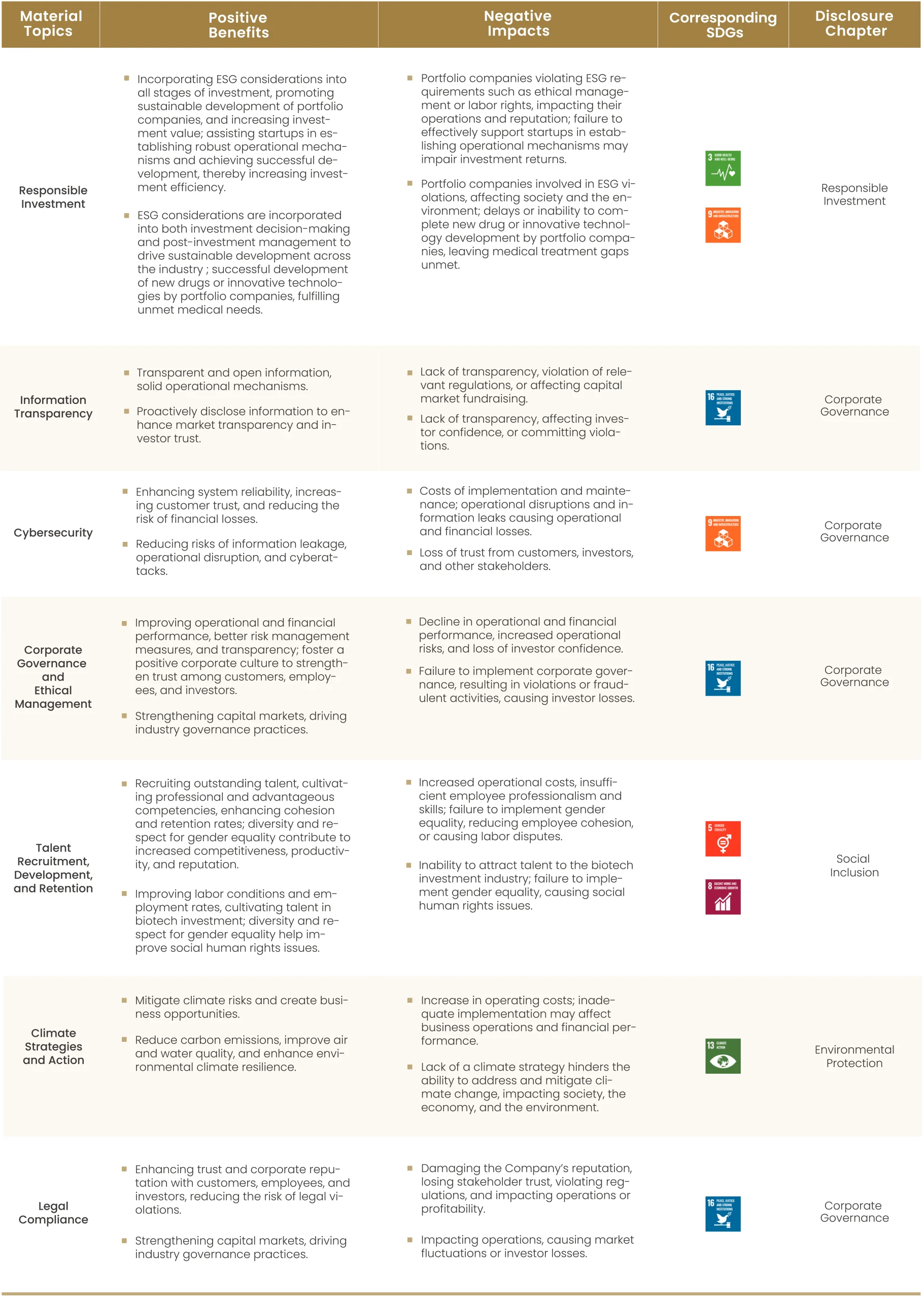
Note:”Positive Benefits” and “Negative Impacts” explanations—Point 1 refers to internal impact, Point 2 refers to external impact.
| Stakeholders | Contact Window | Contact Information | ||||||||||
| Investor/ Potential Investor | Spokesperson: Miss Yolanda Wu Deputy Spokesperson: Miss Lily Wang |
Tel : +886 2-2703-1068 Investor Contact |
||||||||||
| Portfolio Company | Investment Dept. / Miss Hsu | Contact Us | ||||||||||
| Employee | Administration Dept. / Miss Lu | Contact Us | ||||||||||
| Community | Administration Dept. / Miss Lu | Contact Us | ||||||||||
| Press | IR / Miss Wang | Contact Us | ||||||||||