
To manage the various risks that may be encountered in operations and to cultivate a strategy and organizational culture that emphasizes risk management, the ” Risk Management Policies and Procedures ” serve as the Company’s highest guiding principles for risk management. The Board of Directors, the “Sustainable Development and Nominating Committee,” the “Sustainable Development and Risk Management Task Force,” and employees all participate in promoting and implementing these principles. The “Sustainable Development and Risk Management Task Force” reports on risk management operations to the “Sustainable Development and Nominating Committee” and the Board of Directors at least once a year.
The Board of Directors is the highest decision-making body for risk management. It is responsible for approving, reviewing, and supervising the Company’s risk management policies to ensure their effectiveness and bears ultimate responsibility. The Board has established the “Sustainable Development and Nominating Committee” as a functional committee to regularly receive reports from the Company’s Sustainable Development and Risk Management Task Force, supervise the implementation of risk management by the Company and its key subsidiaries, and provide suggestions for improvement regarding the design of risk management policies and procedures. The “Sustainable Development and Nominating Committee” currently comprises five members, including three independent directors, with an independent director serving as the convener and chairperson of the meetings.
The “Sustainable Development and Risk Management Task Force” is the authority responsible for executing risk management. It is mainly in charge of executing tasks such as monitoring, measuring, and assessing the Company’s risks. It shall exercise its powers independently from business units and operational activities. The task force is organized under the Office of the President and reports to the “Sustainable Development and Nominating Committee” and the Board of Directors.
Supervisors of each functional department or business handlers are the first-line responsible units as risk owners for their respective areas. They must carry out their duties in accordance with internal control systems and internal regulations relevant to their businesses and serve as the direct units for initial risk identification, measurement, and monitoring. As second-line responsible parties, departmental supervisors shall be responsible for the risk management of related business operations, and based on the actual operations, review, revise, or supplement internal regulations accordingly.
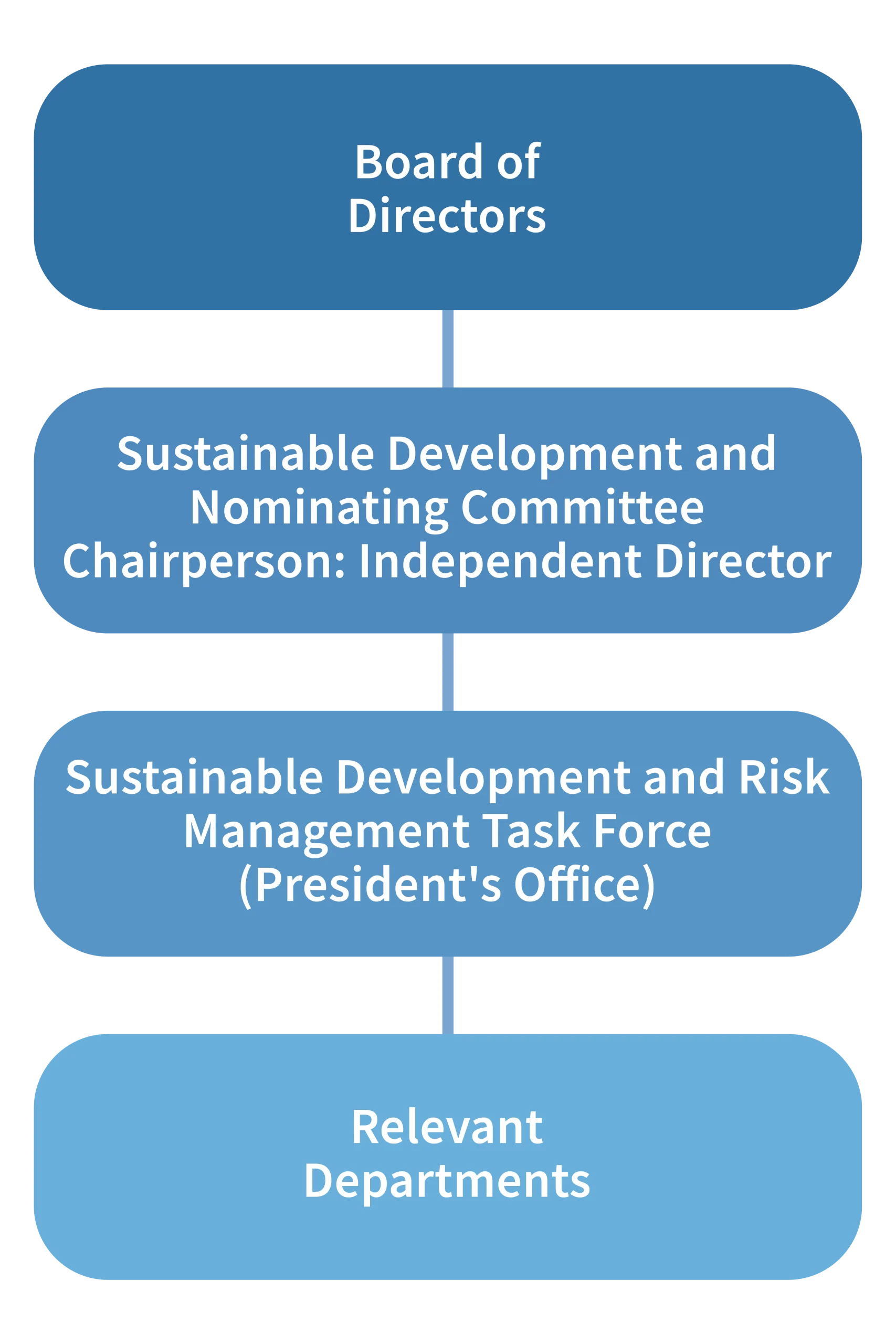
The relevant risk factors are identified from a company-wide operational perspective by the responsible department heads, who assess and analyze the impact of these risks on the company’s operations. Response measures are then developed to ensure that the various risks the company may face in its operations are controlled within an acceptable range.

Risk management principles are integrated into the company’s operational strategies, emphasizing that risk management is not confined to specific departments but is a shared responsibility across all employees.
In identifying risk factors, the company considers a wide range of risks that may affect its business objectives or cause operational disruptions. Sustainability-related aspects, including emerging ESG issues, are also incorporated into the risk identification process. The assessment takes into account the complexity of each issue, relevant scenarios and assumptions, and, where necessary, third-party data sources. Key risk events are identified, and response plans are established to enhance operational resilience. In 2024, a total of 31 risks were identified and assessed.
The likelihood of occurrence and the degree of impact of risk events are used as factors to quantify the risks.
| Rating | Likelihood Description | Definition |
| 1 | Extremely Unlikely | Expected to occur less than once in 10 years |
| 2 | Unlikely | Expected to occur about once in 10 years |
| 3 | Probably | Expected to occur about once in 5 years |
| 4 | Likely | Expected to occur about once in 3 years |
| 5 | Almost Certainly | Expected to occur about once in 1 year |
| Rating | Description of Impact Severity | Financial Impact | Operational Impact | Personnel Impact (Including Employees) | Human Resources Impact |
| 1 | Negligible | Loss or additional expenditure amounting to 0.01% or less of capital (including) (NTD 850,000 or less |
No damage to buildings or equipment; operations unaffected | Causes temporary discomfort or no impact | Replacement manpower accounts for less than 10% of total personnel or recruitment cycle time is less than 1 month |
| 2 | Minor | Loss or additional expenditure amounting to 0.01%–0.05%of paid-in capital (NT$850,000–NT$4.25million) |
Partial damage to buildings or equipment; operations can resume within one day | Causes temporary injury, no follow-up medical treatment or surgery required | Replacement labor accounts for 10%–20% of total workforce or staff recruitment cycle time exceeds one month |
| 3 | Moderate | Loss or additional expenditure amounting to 0.05%–0.5% of paid-in capital (NT$4.25 million to NT$42.5 million) |
Partial damage to buildings or equipment; operations can resume within three days | Causes temporary injury, requiring follow-up medical treatment or surgery | Replacement labor accounts for 20%–30% of total workforce or staff recruitment cycle time exceeds two months |
| 4 | Major | Loss or additional expenditure amounting to 0.5%–1% of paid-in capital (NT$42.5 million to NT$85 million) |
Partial damage to buildings or equipment; operations can resume within one week | Causes permanent or irreversible injury | Replacement labor accounts for 30%–50% of total workforce or staff recruitment cycle time exceeds three months |
| 5 | Substantial | Loss or additional expenditure amounting to more than 1% of paid-in capital (Over NT$85 million) |
Severe damage to buildings or equipment; operations interrupted for more than one week | Causes death | Replacement labor accounts for over 50% of total workforce or staff recruitment cycle time exceeds six months |
A company-level risk matrix is compiled based on risk management practices, with each department formulating corresponding control measures. The “Sustainable Development and Risk Management Task Force” reports the implementation results of risk management operations at least once a year to the “Sustainable Development and Nominating Committee” and the Board of Directors. Ongoing training programs are conducted to strengthen a mindset and culture with heightened risk awareness.
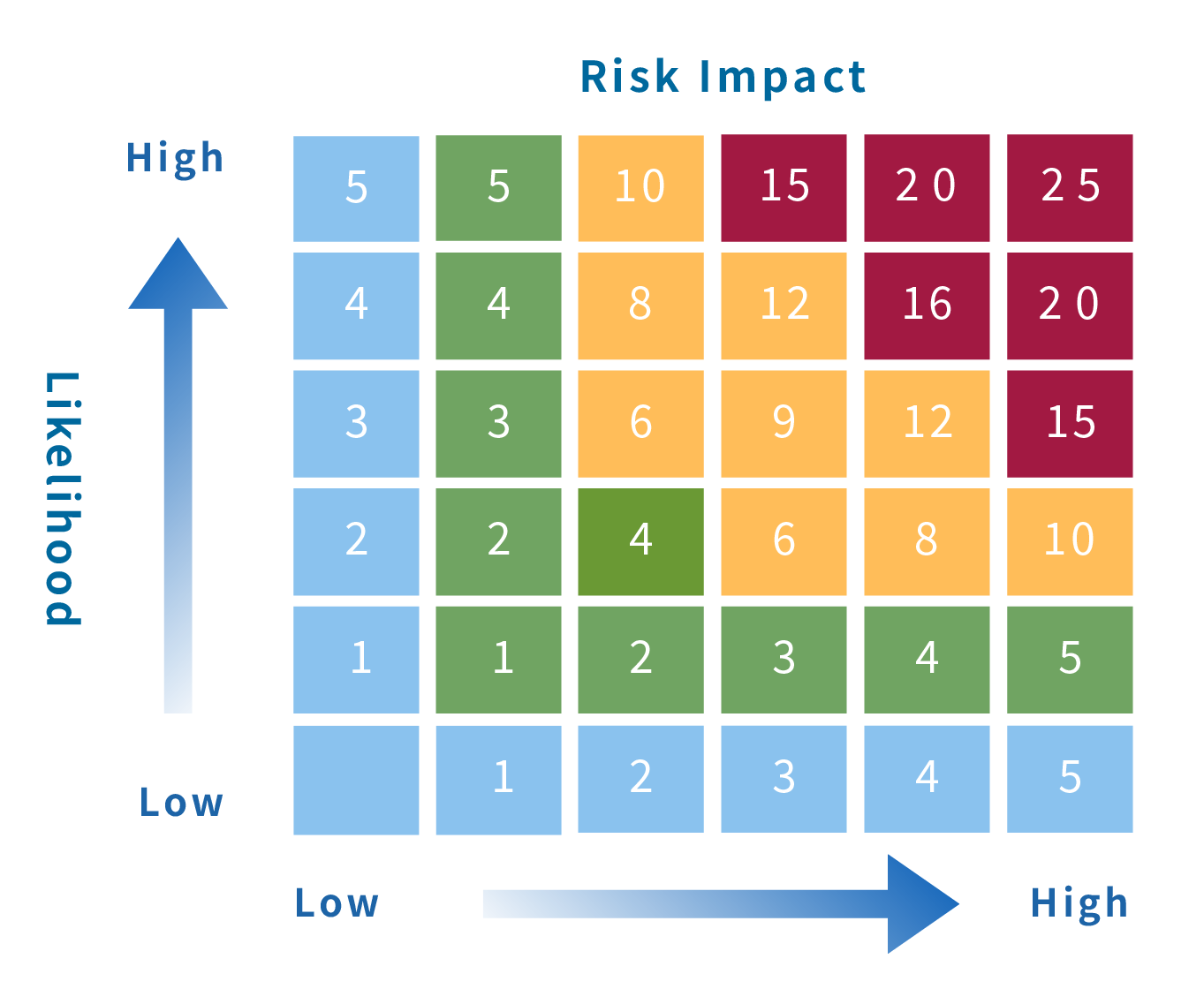
Risk Assessment Results:
The results of the post-control risk matrix comply with the following criteria:
| Score | Risk Level | Risk Response |
| 13~25 | High | Risk Avoidance and/or Risk Mitigation |
| 6~12 | Medium | Risk Sharing |
| 1~5 | Low | Risk Acceptance |
Example
| Risk Factor | Risk Event | Likelihood of Occurrence | Impact Severity | Risk Rating | Risk Level |
| Market Concentration Risk | The investment targets are concentrated in a single market; if that market contracts or experiences high volatility, it may result in losses. | 4 | 5 | 20 | High |
| Intellectual Property Management | Improper management of intellectual property (including trade secrets and trademarks) may affect the company’s operations or business interests. | 2 | 4 | 8 | Medium |
Significant Risk Factors and Corresponding Mitigation Measures/Strategies Identified in the 2024 Risk Assessment
| Significant Risk Factors | Mitigation Measures / Strategies |
| Investment Risk |
|
| Responsible Investment |
|
| Talent Recruitment, Development, and Retention |
|
| Cybersecurity |
|
| Policy Risk |
|
To strengthen the control and response to future risks, in addition to forecasting the aforementioned risks based on past experience, the company also refers to literature published by domestic and international institutions to conduct emerging risk assessments, in order to understand potential impacts and formulate corresponding mitigation measures.
Emerging Risk Assessment in 2024
| Emerging Risk Factors | Risk Description | Risk Response |
| Geopolitical Conflicts | Investment targets may be affected by geopolitical factors, such as the U.S. Biosecure Act, which reduces opportunities for cross-border investment cooperation |
|
| Climate Strategies and Actions | Under the impact of global climate change, physical risks such as droughts and typhoons are intensifying, thereby increasing operating costs. |
|
| Declining Birthrate and Talent Gap | Facing a declining birth rate and the strong talent attraction of Taiwan’s technology industry, the company is at risk of a talent gap that could potentially impact operations. For example, a shortage of cybersecurity professionals may expose the company to information security risks, while a lack of skilled investment personnel could directly hinder the development and post-investment management of investment projects, ultimately affecting revenue. |
|
Internal Audit Status
The Audit Office, in accordance with the Company’s “Risk Management Policies and Procedures” and other relevant regulations, conducted the 2024 risk management audit for Diamond Biofund and its subsidiaries. Through sampling audits of risk assessment reports, forms, records, and operating procedures, it was confirmed that the identification, assessment, monitoring, reporting, and response of risk evaluation were all implemented in accordance with the risk management process, and no major violations were found.